
Stakes, Not Sin
On What Divides the Human from the Divine

In the fifth book of the Iliad a mortal wounds two gods in a single afternoon, and the poem stops, twice, to tell us what comes out of them. Diomedes drives his spear through Aphrodite’s wrist, and what flows is not blood but ichor, the fluid of the deathless, and the poet pauses over the difference: the gods eat no bread and drink no wine, and so they are bloodless, and so they are called immortal. A little later the same mortal wounds Ares, who bellows like ten thousand men and flees to Olympus and is healed before the scene is over, for, the poem says, he was in no wise of mortal stuff. Aphrodite is mocked by the other goddesses. Zeus laughs at her. By nightfall the gods are whole again, and the only ones left on the field who will not get up are the men.1
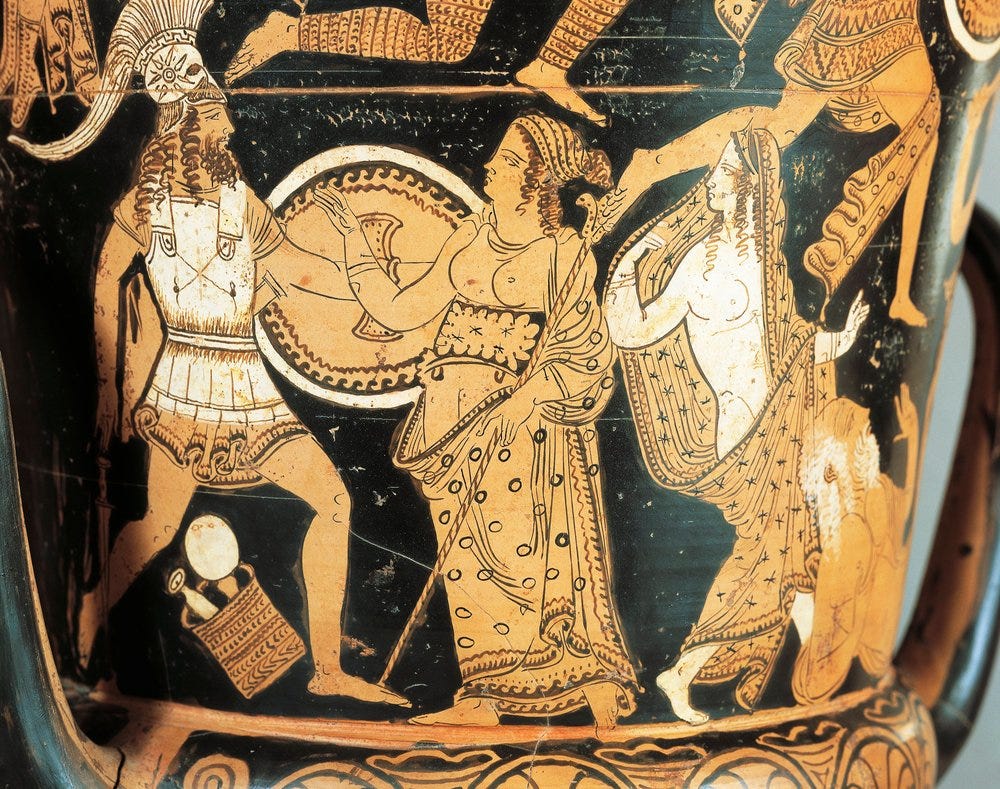
I have gone back to this passage for years without being sure what kept me there, and I am still not certain I have it. The obvious reading is that the gods are simply more powerful than we are, and the scene is a joke at the expense of a mortal rash enough to fight them. But that is not what stays with me. What stays with me is the ichor, the careful detail of the wrong-colored blood, as if the poet wanted us to notice not that the gods cannot be hurt, because plainly they can, but that nothing about being hurt finally takes anything from them. I want to set out what I think this means, and I should say at the start that I am not fully in command of it, because the thing I am reaching for sits at the edge of what I can put plainly, and more than once in what follows I will have to stop and admit I cannot get all the way to the bottom of it.
Begin with the thing it is not, since that is where everyone else begins and it is worth seeing why they are wrong to. We are told, and the religions mostly agree, that sin is what divides the human from the divine, that the gap is moral, that we fall short of a holiness the gods possess. The gods themselves make nonsense of this. Zeus deceives and forces himself on women; the gods of the Mesopotamian flood drown the world because its noise has been spoiling their sleep, and then crouch against the wall of heaven, terrified, at the size of what they have done;2 Krishna counsels the lies that win the war at Kurukshetra;3 the God of the Hebrew Bible hardens a man’s heart so as to punish him for the hardness, and stakes a faithful man’s children on a wager with the adversary to see what the man will do under torture.4 These are not marginal. The traditions know they are there. So sin cannot be the line, because the gods cross it more freely than we do and are not marked by the crossing. If transgression were the measure, the gods would be on our side of it, and lower down.
The line is somewhere else, and I think the ichor shows where, though it took me a while to trust so small a thing to carry so much. A god can be pierced. A god cannot be emptied. Aphrodite bleeds, but she bleeds the blood that does not run out. This is the whole of it, or nearly, set down in one image by a poet who understood his own gods better than the theologians who came after him. The gods are not spared pain. They are spared loss. And it is loss, I want to argue, and not transgression and not even death, that turns out to be the thing we have and they do not.
I have to be careful with the word, because the easy form of this claim is plainly false, and the strongest objection to it is correct, and I would rather meet the objection now than pretend it is not waiting. The easy form says the difference is death: the gods are immortal, we die, and our dying is the source of whatever weight our lives have. But a being could be deathless and still lose everything. An immortal could watch each friend turn cold, each love become a stranger, each city he loved fall, and go on living after all of it was gone. Deathlessness does not buy you out of loss. The philosophers who have pressed hardest here, against the old idea that an endless life would be a good one, are right that living forever and being safe from loss are not the same condition,5 and if my argument rested on death it would fall to them. So I will not rest it on death. The privilege of the gods runs deeper than not dying. It is that nothing is ever finally at risk for them. They can be shamed, wounded, even grieved, as Zeus grieves the son he is fated to allow to die and sheds, the poem says, tears of blood that change nothing and save no one.6 But the wound closes. The grief is real and takes nothing that does not come back. The gods have the whole furniture of a mind like ours, the appetites and the jealousies and the long memories, with a single piece removed: the possibility of a loss that cannot be undone. Take that one piece away and you have a god. I find I half-believe and half-doubt this even as I write it, because it seems too large a conclusion to hang on the color of a fluid, and yet every place I test it the conclusion holds.
It would be convenient to treat all this as a quirk of the Greek imagination, one cheerful and badly behaved pantheon, and to leave it there. I do not think we can. It appears to be what the human mind does whenever it is left alone to make a god. The students of religious cognition have a sober version of this. When the mind reaches for the idea of a god, it reaches first not for a moral lawgiver but for an agent very much like a person, with ordinary beliefs and wants and angers, who differs from a person in a small number of striking ways: he does not die, he cannot be seen, he knows what he should not be able to know. The default god of the imagination is human-tempered and beyond loss. The watching, judging, morally exacting high god, the one who minds how strangers treat each other and punishes the secret sin, comes later, a thing societies grow when they get large enough to need it.7 The moralizing of god is a coat put on afterward. Underneath it the older figure keeps showing through, which is why even the most moralized traditions cannot keep their gods well-behaved. Zeus and his affairs, Krishna and his mischief, the wrath the prophets keep having to explain away: the stakeless agent breaks back through the moral surface the way a buried wall shows through a later street. The amoral god is not a mistake the traditions failed to fix. He is what they were built on top of.
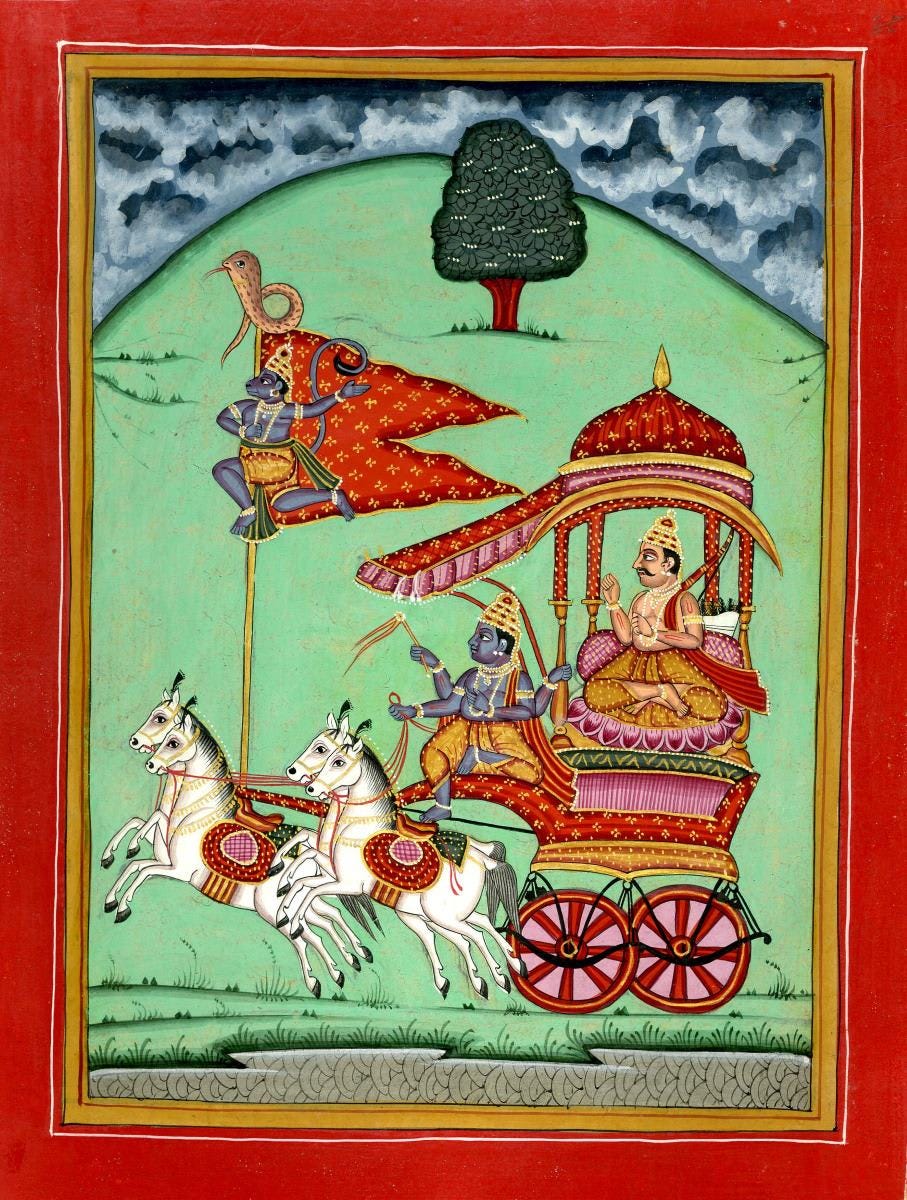
And here the traditions, which agree on almost nothing else, fall into a kind of agreement. They keep laying the moral weight on what ought, by their own theology, to be the wrong side. The gods are the higher beings, and yet when these stories want a figure of real moral seriousness they reach down, to the mortal. In the Iliad the gods watch the war the way we watch a game we have bet on, leaning in, taking sides, pulling a favorite out of danger when the play turns against him, and the one who carries the tragic weight of the whole poem is Hector, who can lose, who does lose, whose death drags his city down behind him.8 The gods cannot be tragic. They have no exposure to make tragedy out of. In the Babylonian flood the gods are petty and frightened and self-serving, and the figure who comes through with dignity is the man who builds the boat and keeps faith in the dark. The same shape turns up where I least expected to find it repeated, in a world that owes the Greeks nothing. In the Mahabharata there is a formula: where Krishna is, there is victory.9 His presence on the field settles the outcome in advance. He cannot lose. And so the moral weight of the war, the guilt and the grief and the long reckoning afterward, falls not on the god who guaranteed the result but on Arjuna, who has to go on living with what was done to secure it. The stakes fall according to what each one is. The one with skin in the game is the man. The god watches, and guarantees, and plays, and is not harmed.
Why should stakes carry this kind of weight? I think because the goods we care about most are built out of the possibility of loss, and cannot be built any other way. Courage is a manner of standing in relation to what can be taken from you; a being who can lose nothing cannot be brave, because there is nothing for the bravery to be about. The love that means anything is an attachment to a particular and perishable thing, and the attachment and the perishability are not two facts but one. Grief is the proof a love was real, and grief is closed to a being who cannot lose. Nussbaum put this against the whole long effort to make the good life safe: the very excellences we prize are made out of our exposure, and a life sealed against loss would not be a steadier version of a human life but a smaller and different thing, lacking the organs by which our goods are even possible.10 The gods are that sealed life. They have the appetites without the exposure, and so they have the look of our virtues without the substance of them. They can perform a generosity, but nothing it costs them is gone by morning. They can perform a courage, but they are in no wise of mortal stuff.
This is also, I think, why the stakeless god can be feared and worshipped and admired but not, in the full sense, loved. Love fastens onto what can be lost. We do not love the sun. We depend on it and are warmed by it and would die without it, but love is not the word, because the sun is not the kind of thing that can be taken from us by the kind of accident that makes love what it is. There is something true in the old idea that we resent most not the being far above us but the one just above us, near enough to measure ourselves against, and that the truly remote is adored rather than envied.11 But I do not want to lean on the envy, because the deeper point is simpler: a being with nothing at risk gives us nothing to hold. You cannot cherish what cannot be lost, because cherishing is the posture we take toward fragile things, the hands cupped around what might spill. The gods cannot spill. And so for all their beauty and their power they are, in the exact sense, beyond our love: there is nothing in them to fear for, and to be unable to fear for a thing is to be unable to love it.
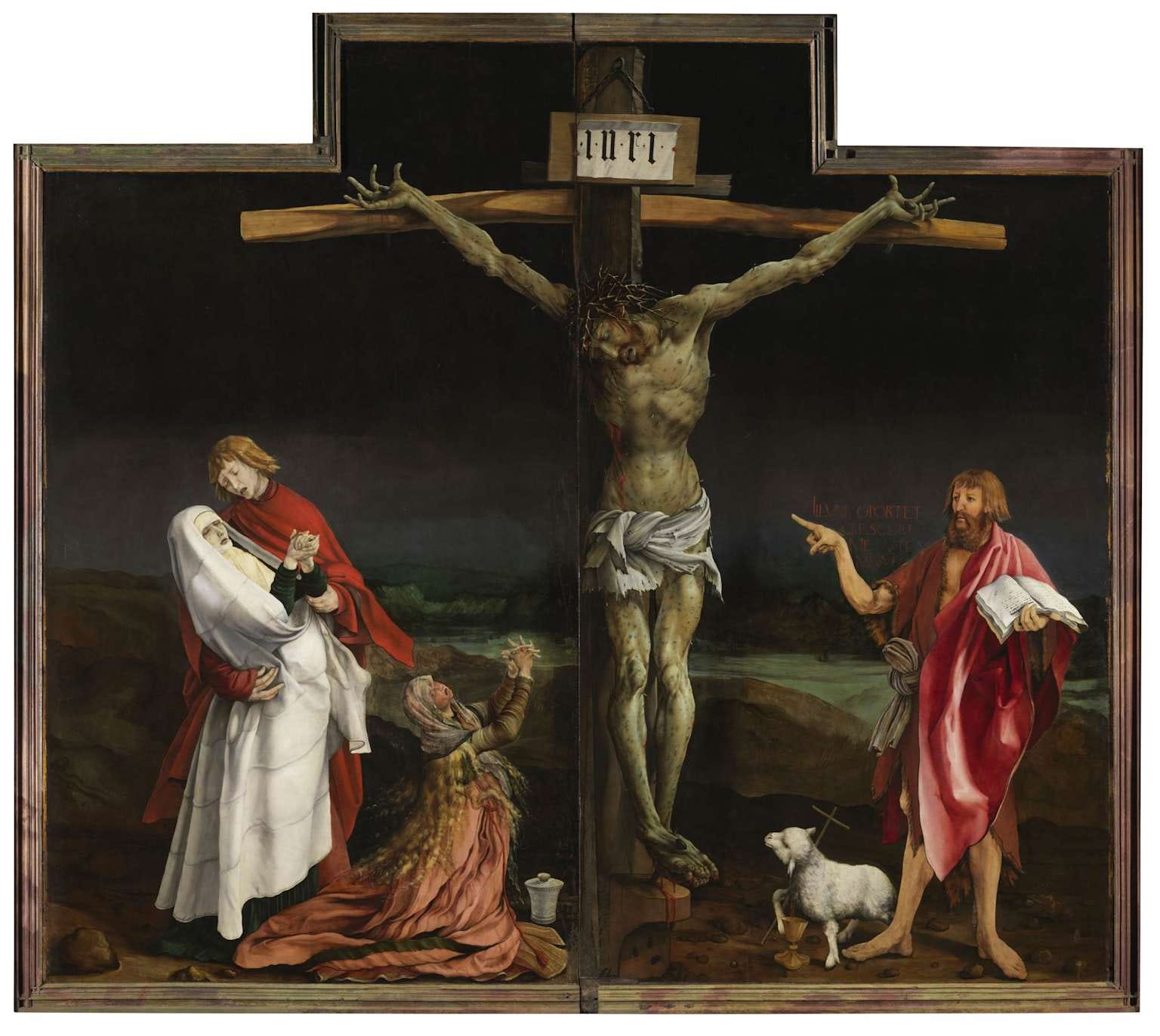
If that is right, the next step looks obvious, and for a while I thought it would be. If lovability needs losability, then a god who wanted to be loved would have to take on stakes, would have to come down into the field of loss and make himself able to lose. And there is, in one tradition, precisely this. The Christian claim is that God emptied himself, took the form of a servant, was born, and died, and that on the last night he sweated and begged to be spared, and on the cross cried out that he had been forsaken. Whatever one finally makes of it, the shape of the claim is not in doubt: a god who makes himself killable. The word the old hymn uses, that he emptied himself, has been fought over for centuries, and the readers I trust most now think it does not mean that he poured the divinity out of himself but that the emptying simply is the becoming-human, the taking-on of a life that can end.12 Here, it seemed to me, was a god with stakes, a god who can lose, and so, by everything I had said, a god who can be loved.
I expected the other great traditions to give me the same movement, and I went looking for it, confident I would find it, because the intuition behind it felt too strong to belong to one religion alone. I was wrong, and the way I was wrong is the most useful thing I have to report. I will take the case I was surest of first, because it is the one that came apart most instructively in my hands.
I assumed the Hindu avatar would be my second instance. The god descends; what could be plainer. I had the paragraph half-written before I went back to check it, and when I checked it the parallel dissolved, and it took me longer than I would like to admit to see why. The avatar descends, but he descends again and again, not once and for all; and the body he descends into is, on the tradition’s own account, made of pure matter, perfect rather than fallen; and the agonized, self-emptying suffering that marks the Christian descent is, for the most part, simply absent.13 He comes down without coming down into loss. I was ready to set the case aside as a failure when I noticed where, in that tradition, the love actually attaches, and it sent me back to my own argument with more confidence than I had started with. The Krishna who is loved is not the serene cosmic player of the philosophers, whose every act is weightless sport. The Krishna who is loved is the Krishna of Mathura and of Dvaraka, who has a family and a city and a dynasty, and who loses all of it, and who dies at last under a grieving woman’s curse with his people destroyed around him. The devotion knows that the lovable god is the one with stakes. But watch what it does with the stakes. It gives them to the worshipper. The highest religious mood in that tradition is the mood of separation, the lover’s anguish at the absent beloved, and the suffering of that separation is carried by the devotee. The lover suffers. The beloved plays. Even the tradition that comes nearest to a god of loss hands the loss back to the mortal.14
The Bodhisattva looked, for a while, like the strongest case of all, stronger than the Christian one, because he refuses the exit on purpose. He will not pass into the peace held out to him. He vows to stay in the world of suffering as long as the world lasts, to be the medicine and the doctor and the boat and the bridge, and in the most extraordinary passages he goes down into the depths of hell, the texts say, like swans settling onto a pool of lotuses, for the sake of the beings still trapped there.15 No one stays in the field of loss more deliberately than this. And yet I found, reading further, that the tradition which sends him there has, with great care, made him unable to be wounded by it. He is no longer subject, the doctrine says, to the eight worldly things, to gain and loss, to honor and dishonor, to pleasure and pain. His compassion is a compassion without attachment, and Santideva, reasoning his way toward it, dissolves the very ground on which a loss could stand: since there is no self, he argues, there is no owner of any suffering; the one who suffers does not exist; to whom, then, could the suffering belong? No suffering belongs to anyone.16 It is to be relieved because it is suffering, not because it is anyone’s. And the modern interpreter I find hardest to argue with draws the conclusion that gives the thing away: the Bodhisattva’s compassion is the higher kind, he says, precisely because nothing of the self is at risk in it. It does not tire, it does not break, it does not suffer the fatigue that wears down our own caring, because, knowing in the end there is no one to be saved, it does not have to take itself seriously.17 This is the exact reverse of the cross. Where the Christian God’s compassion is meant to be real because it is felt as loss, in the garden, in the cry of dereliction, the Bodhisattva’s is perfected by having no loss in it at all. He stays where the suffering is and cannot be touched by it. It is nearness without exposure, presence in the field of loss by one who has been made incapable of losing.
The boldest case is the last, and it fails in the most interesting way, by running backward. There is a teaching that before God could make anything he first had to withdraw, to contract himself, to open an empty space where something that was not God could be. This is the nearest thing in the Jewish mystical tradition to a self-emptying, and the comparison to the Christian descent has been made more than once. It comes apart in two directions at the same time. On the reading that won out, carried by the Hasidic masters and stated flatly in their central book, the contraction is not to be taken literally at all: God did not really withdraw, did not really limit himself, did not really absent himself from anything; only the appearance was withdrawn, so that finite minds could bear to exist, and from God’s own side nothing whatever changed.18 On that reading there is no self-emptying and no diminishment and no stakes, and the parallel simply evaporates. And on the other reading, the literal one, the contraction goes the wrong way. The greatest modern scholar of the tradition put it exactly: the word does not mean the concentration of God at a point but his retreat away from a point.19 The mystical God hollows out a vacuum and steps back from it. The Christian God fills a body and steps into it. One is a withdrawal and the other an entrance; the figure for the first is exile, the figure for the second is incarnation; they are not one shape under two names but each other’s mirror. What suffering the tradition does place in the divine, the exile of the indwelling presence scattered through a broken world, is a suffering that comes upon God by accident, as the consequence of a cosmic breakage, and not a loss freely taken up. Even here the god does not choose to be able to lose.20
I had meant to gather three companions for the Christian case and I had ended with none, and the failure turned out to say more than the success would have. A pattern had been forming under my hands while I looked for parallels, and I am fairly sure now what it is, though I hold it a little loosely. It is not cowardice in the traditions but something more like an instinct, and the same instinct everywhere. Each of them, when it imagines a god who matters, who comes near to suffering, keeps one thread tied to safety. The avatar’s incorruptible body, the Bodhisattva’s freedom from attachment, the mystical God’s withdrawal that is either unreal or merely a retreat: each is an exit, a way for the god to stand in the neighborhood of loss without being subject to it. And each tradition presents its own exit not as a limit on the god but as his perfection. Pure compassion is held to be better than wounded compassion. Unchanged transcendence is held to be higher than diminishment. The serene player is held to be more divine than the grieving one. The reticence is principled. The traditions are telling us, with something close to one voice, that a god who could really lose, who could be really wounded, who had no exit and no rope and no way back up, would have crossed a line past which he no longer looks like a god. He would look like us.
Even Christianity keeps something in reserve at the end, and I should say so, because the place where it does is the place where my argument is most exposed and I would rather not hurry past it. The mainstream of its own theology could not finally accept a God who suffers as God, and drew a line through the middle of the one who descends: the divine nature stays untouched, full, impassible, and it is only in his humanity that he suffers and dies. The Impassible suffered, the old formula runs, holding the two halves apart.21 And the deepest defenders of that line made an argument I do not think I can simply wave away, because it is not a foolish one. A love that can be lessened by the beloved’s suffering, they said, a love that is moved and depleted from outside, is a smaller love than one that pours out of its own fullness, undeflected, needing nothing. On their account the impassible God is not the cold one but the truly loving one, and the vulnerable god of my intuition is a god whose love has been made contingent and therefore made less. I do not believe this, but I cannot show it is wrong, and its being there means that even the tradition of the descending God keeps, in the end, a place to descend from and a place to return to. The emptying is a free gift out of a fullness that is never actually emptied. The God who comes down still has somewhere to stand.
Set all of this beside a distinction I keep coming back to, because it is the one that makes the shape of the thing go clear for me. There is a difference between the one who designs a world and stands outside it, seeing the whole and risking nothing, and the one who lives inside the world, seeing only the fog right around him and able to lose everything he has. The first sees clearly and cannot lose. The second sees badly and can lose it all. The stakeless god is just the first standpoint made permanent and made divine: the designer who never enters his own design, the watcher in the perfect seat. And the descent, in every tradition that tries it, is the attempt to cross from the first standpoint into the second, to get inside the world from outside it. What I have been describing, the exit, the thread tied to safety, is the refusal to make that crossing complete. The god goes down into the fog still roped to the high place, and the rope is the pure body, or the freedom from attachment, or the unreal withdrawal, or the impassible nature that suffers only at arm’s length. He visits the country of loss. He does not become a native of it.
The human wears no rope.
This is the whole of what I have been trying to say, and now it can be said quickly. We did not climb down into the inside of the world from anywhere. We were born here. There is no high place we came from and no rope back up. The loss that finds us is not a fiction we can see through, the way the Bodhisattva sees through it; nor a body we agreed to put on, the way the descending God puts on flesh; nor a light we are only declining to shine. It is ours, and it is real, and it cannot be disowned or seen past or returned. When we lose what we love we do not get it back at the next sunrise. We do not bleed ichor. We bleed, and we do not always get up, and when we do get up we are missing something that does not grow back.
And this, which looks at first like the worst of our poverty, is the one thing the gods cannot do. To take a life that holds its own losses and its own ending, to see the whole of it, and to say yes: yes to the having and yes to the losing, the second yes spoken over the very disappearance the first yes was glad of. This is an act open only to a being who can really lose, which is to say only to a being with genuine stakes, which is to say only to us. The stakeless gods cannot perform it, having nothing to lose and so nothing whose loss they could affirm. The Bodhisattva cannot perform it, having dissolved the self that would own the loss, and an unowned loss is not a thing that can be affirmed, only a suffering to be impartially relieved. The descending God performs something close to it, but performs it as a gift, out of a fullness that is never spent, with the return already secured. Only the mortal affirms a loss that is genuinely and unrecoverably his own, with no exit and no rope and no fullness held in reserve and no morning on which the thing will be handed back. The cost is total, and that is the reason the affirmation means anything. An affirmation that costs nothing affirms nothing.
I wish I could say I know who is capable of this, and I do not, and the not-knowing is the place my argument runs out. It is one thing to show that the affirmation is ours to make and the gods’ to envy. It is another to say whether it lies open to anyone at all, or only to the few who have already come out the far side of some long loss and can look back down the length of it. The figures who manage it in the old stories are not ordinary men in the middle of their lives. They are men at the end of an arc, with the whole of it behind them and visible. Whether the same yes is available to someone still inside the arc, still in the fog, with the loss not yet survived but only feared, I cannot say. I suspect it is rarer than I would like it to be. I am sure it is not guaranteed by being mortal; mortality only makes it possible, and a possibility is not a promise.
What I am left holding is smaller than a victory and I think truer than one. We have had the account backward. We have pitied ourselves for our exposure and envied the gods their freedom from it, when the freedom we envied is the very thing that shuts them out of the one act that would have justified the whole arrangement. The capacity for loss is not the wound in us that the gods were spared. It is the organ by which we can do what the gods, in all their deathless ease, were never in a position to do. They can make and watch and laugh and be whole again by morning. They cannot say yes to the loss of what they love, because they cannot lose what they love, and so the deepest yes a being can say is closed to them by the very immortality we spend our lives wishing we shared. We do not have to come down into the world of stakes. We were never anywhere else. And the yes we are able to say from here, the clear-eyed yes to a life that includes its own ending, is a yes no god has ever been in a position to say, whether or not, on any given day, we manage to say it.
The gods bleed ichor and are whole by morning. We bleed blood, and now and then one of us, knowing what it costs and that none of it will be given back, says yes to the whole of it anyway. I do not think that is the consolation prize of being mortal. I think it is the thing the immortals, for all their freedom, were never able to do, and I think it is worth more for being so hard to do and so far from certain. But here I reach the edge of what I can say plainly, and I would rather stop than spoil it by pretending to more.
Homer, Iliad 5.330–351 (the wounding of Aphrodite) and 5.855–909 (the wounding of Ares), with the explanation of divine bloodlessness at 5.339–342: because they eat no bread (sitos) and drink no wine (oinos), the gods are anaimones, bloodless, and athanatoi, deathless. The diet is the hinge of the logic. Mortal blood is built from mortal food; the gods take ambrosia and nectar instead, the names for which point at deathlessness (ambrosia from a-mbrotos, immortal; nektar conventionally, if conjecturally, parsed as death-overcoming). Dione’s consolation at 5.382–404 supplies the catalogue of divine wounds that did not stick: Ares bound thirteen months in a bronze jar, Hera shot in the breast, even Hades struck by one of Heracles’ arrows, every one of them healed. Translations throughout are Lattimore’s. One detail repays attention, since the essay leans on it: the word ichor did not stay divine. By the Hippocratic writers it had become the name for the thin watery part of the blood, the serum, and later for the acrid discharge that weeps from an ulcer. The fluid that marks the gods as beyond loss became, in the physicians’ mouths, the word for the seepage of a body going wrong. I have not built on this in the body. It sits under the image, and I find it hard to believe Homer would have minded the irony.
The flood is told in the eleventh tablet of the standard Babylonian Gilgamesh and, earlier, in the Atrahasis poem; I follow Andrew George, The Epic of Gilgamesh (Penguin, 2003). The gods loose the deluge and then, terrified by it, cower like dogs crouched against the wall of heaven (XI.115), and Ishtar cries out in regret over the destruction of her own people. That the figure of moral seriousness is the mortal, Uta-napishti, who builds the boat and keeps faith through the dark, while the gods panic and recriminate, is not my imposition; it lies on the surface of the text. William Moran’s essays on Atrahasis (collected in The Most Magic Word, 2002) make the point with more authority than I can muster. The gods cause the loss and are not touched by it. The man bears it and is.
The deceptions that secure the victory are concentrated in the war books of the Mahabharata: the half-truth that breaks Drona (Ashvatthaman is dead, the name borne by a slain elephant), the use of Shikhandin to bring down Bhishma, the killing of Karna while his chariot wheel is mired, the felling of Duryodhana below the belt. Krishna counsels or sanctions each. I take the standard scholarly view that these are not lapses in the narrative but its moral engine, the price of a victory the poem refuses to call clean. The point for the argument is narrow: the god who advises the deceptions carries none of their weight, and the men who take his advice carry all of it.
Exodus 7–14 for the hardening of Pharaoh’s heart, where the text moves pointedly back and forth between Pharaoh hardening his own heart and the LORD hardening it for him, the better to multiply his signs; Job 1–2 for the wager, in which a faithful man’s children, servants, and health are destroyed to settle a question between God and the satan. Whether these acts are defensible has been the work of theodicy for two millennia and is not my subject. My subject is the asymmetry they expose: done by a man, each would be plain wickedness; done by God, each is held to fall outside the categories that would condemn it. That is the Euthyphro problem in narrative dress, and the heretics who could not stomach it, Marcion, the Gnostics with their lesser creator-god, were trying to relocate the cruelty rather than to excuse it. The orthodox answer, when it finally arrives in Job 38, is not a justification but a change of subject: where were you when I laid the foundations of the earth. It is the voice of a being to whom nothing is at risk, addressing one to whom everything is.
The locus classicus is Bernard Williams, “The Makropulos Case: Reflections on the Tedium of Immortality,” in Problems of the Self (Cambridge, 1973), arguing that an endless life would empty out the very desires that give a life its shape. I lean on the conclusion that immortality and meaning stand in tension; I do not lean on Williams’s route to it, because the route has been well battered. John Martin Fischer (“Why Immortality Is Not So Bad,” 1994, and later essays) shows that Williams runs together two things that come apart, deathlessness and the exhaustion of desire, and that a deathless life need not be a bored one; Lisa Bortolotti, Yujin Nagasawa, and Connie Rosati press related objections. What survives the battering, and what I actually need, is narrower and harder to dislodge: not that immortality would be tedious, but that invulnerability to loss would be weightless. Here Williams’s critics are quietly on my side, since Fischer’s own wedge is precisely that a deathless being could still lose, and a being who can still lose still has stakes. Samuel Scheffler’s Death and the Afterlife (Oxford, 2013) supplies the positive form of the point: it is scarcity, the fact that time runs out and things can be taken, that pressures us to value at all. The gods are not damned by deathlessness. They are damned by having nothing to lose, which is a different and worse condition, and the one Williams’s opponents inadvertently sharpen for me.
Iliad 16.459–461: Zeus, watching his son Sarpedon go to the death the Fates have fixed, sheds tears of blood upon the ground, and does not save him. I have not embellished the detail. A god can grieve, and grieve in blood, and lose nothing, because the grief is not permitted to alter the outcome and the griever is not diminished by it. It is the clearest single image in the poem of feeling without stakes.
The claim that the mind’s default god is a humanlike agent rather than a moral lawgiver rests on the cognitive science of religion: Stewart Guthrie, Faces in the Clouds (Oxford, 1993), on the reflexive over-attribution of agency; Pascal Boyer, Religion Explained (Basic Books, 2001), on gods as minimally counterintuitive agents, ordinary minds with a few violations of expectation. The further claim, that the watching, morally exacting high god is a later cultural overlay bound up with the scaling of cooperation, is Ara Norenzayan’s, Big Gods (Princeton, 2013), with support from the cross-cultural fieldwork of Benjamin Purzycki and colleagues (“Moralistic Gods, Supernatural Punishment and the Expansion of Human Sociality,” Nature 530, 2016). I should say plainly that the sequence is contested: Harvey Whitehouse and colleagues, drawing on the Seshat databank (“Complex Societies Precede Moralizing Gods Throughout World History,” Nature 568, 2019), argue that moralizing gods follow social complexity rather than enabling it, and the Seshat data have themselves been disputed. The quarrel is over timing and cause. It does not touch the point I am borrowing, which is only that the bare, humanlike, amoral god is cognitively prior, and that the moral god is built over him. The traditions confirm as much each time the older figure breaks back through.
James Redfield, Nature and Culture in the Iliad: The Tragedy of Hector (Chicago, 1975), argues that Hector, not Achilles, is the poem’s tragic center, precisely because his exposure is total and his fall drags the city after it. Jasper Griffin, Homer on Life and Death (Oxford, 1980), describes the gods as the poem’s audience, watching the suffering of mortals with an engagement that costs them nothing. Put the two readings together and the structure is plain: tragedy requires stakes, the gods have none, and so the gods cannot be tragic, only entertained.
The formula closes the Bhagavad Gita: where there is Krishna, lord of yoga, and where there is Arjuna the archer, there is fortune, victory, and prosperity (18.78). Ruth Cecily Katz built her reading of the epic around it in Arjuna in the Mahabharata: Where Krishna Is, There Is Victory (South Carolina, 1989): Krishna’s presence guarantees the outcome, the outcome is therefore never in doubt, the god therefore has nothing at stake, while Arjuna, who must afterward live with what the victory cost, has everything. I have put the point in my own words in the body. The reading is hers.
Martha Nussbaum, The Fragility of Goodness: Luck and Ethics in Greek Tragedy and Philosophy (Cambridge, 1986), is the sustained modern case that the human goods most worth having, love and friendship and citizenship and courage, are constituted by their openness to luck and loss, and that the long philosophical effort to make the good life invulnerable, the Stoic ambition and, differently, the Platonic one, buys safety at the cost of the goods themselves. My single sentence compresses a book. The reader who wants the argument rather than the slogan will find it there, above all in the chapters on the tragedies and on the Symposium.
The observation that scorn falls not on the wholly superior but on the one near enough to be measured against is developed by Aaron Ben-Ze’ev in The Subtlety of Emotions (MIT, 2000), where proximity is a condition of envy: we do not envy the unreachable, we envy the rival. The Greeks had the divine version, phthonos theon, the envy of the gods, which falls on the mortal who climbs too near them. Helmut Schoeck’s Envy (1966; ET 1969) remains the fullest treatment of the leveling impulse as a social force, and Susan Wolf’s “Moral Saints” (Journal of Philosophy, 1982) supplies the adjacent and more uncomfortable point, that we do not in fact love the morally perfect and feel the saint as a reproach rather than a friend. I have kept all of this to one sentence in the body, because it is a grace note and not a pillar. The load-bearing claim is the simpler one: we cannot love what cannot be lost.
Philippians 2:6–7, the Christ hymn: he did not count equality with God a thing to be grasped (harpagmos) but emptied himself (ekenosen), taking the form of a servant. The Gethsemane scene is Mark 14:32–36; the cry of dereliction, Mark 15:34, quoting Psalm 22:1. The exegetical question is what the emptying empties. The kenotic theologians of the nineteenth century, Gottfried Thomasius in Germany and Charles Gore in England, held that the Son set aside certain divine attributes in order to become human. The reading I follow, and which now holds the field, is argued by Gordon Fee (Paul’s Letter to the Philippians, Eerdmans, 1995; Pauline Christology, 2007) and N. T. Wright (“Harpagmos and the Meaning of Philippians 2.5–11,” Journal of Theological Studies 37, 1986): the emptying is not a subtraction of divinity but its expression, he emptied himself by taking, the self-emptying simply is the becoming-human and the accepting of a death. On either reading the fact the argument needs holds firm: this is the one tradition that lets its God take on a life that can actually end.
Noel Sheth, “Hindu Avatara and Christian Incarnation: A Comparison,” Philosophy East and West 52, no. 1 (2002): 98–125, is the careful treatment that took the easy parallel away from me. Sheth sets out the disanalogies: the avatar’s body is not ordinary fallen matter but suddha-sattva, pure substance; the descent recurs across the ages, the standard list running to ten, rather than happening once for all; and the kenotic note, the God who suffers and is diminished, is largely absent, the avatar’s suffering being for the most part apparent, undertaken as lila, play, rather than undergone as loss. The avatar comes down without coming down into loss. That this is the precise point at which the Hindu and Christian pictures part is Sheth’s finding, not mine. I have only drawn the consequence.
The destruction of Krishna’s own people, the Yadavas, who fall to drunken slaughter among themselves, and his death from a hunter’s arrow, are told in the Mausala Parva, the sixteenth book of the Mahabharata; the curse that dooms them is Gandhari’s, pronounced in her grief over the war (Stri Parva 11) against the god who let it happen. The devotion that loves Krishna most fiercely is the one built around viraha, love-in-separation, whose classic study is Friedhelm Hardy, Viraha-Bhakti: The Early History of Krsna Devotion in South India (Oxford, 1983); John Stratton Hawley’s work on the cowherd Krishna (At Play with Krishna, Princeton, 1981) traces the same structure. The decisive detail is where the tradition lodges the suffering of separation. It lodges it in the devotee. The god is absent, or at play; the lover burns. Even in the warmest theism of loss, the one who loses is the mortal.
Santideva, Bodhicaryavatara, in the translation of Kate Crosby and Andrew Skilton (Oxford, 1995). The vow to be a protector for the unprotected, a guide for travellers, a boat, a bridge, a causeway for those who long for the further shore is at 3.17–18; the great closing aspiration, for as long as space endures and for as long as the world lasts, may I too abide to dispel the misery of the world, is at 10.55; the image of plunging into the hells like wild geese descending upon a bed of lotuses comes in the tenth chapter. The eight worldly concerns (astalokadharma), gain and loss, fame and disgrace, praise and blame, pleasure and pain, from which the realized one stands free, are a commonplace of the tradition, set out in Vasubandhu’s Abhidharmakosa among many other places. The vow keeps the Bodhisattva in the field of suffering. The doctrine of the eight concerns keeps him untouchable within it. Both hold at once, and their holding at once is the whole of the problem.
Bodhicaryavatara 8.101–103, the hinge of Santideva’s argument for impartial compassion: because there is no possessor of suffering, no self that owns it, suffering is to be relieved without distinction, simply because it is suffering and not because it is anyone’s. Paul Williams, in Altruism and Reality: Studies in the Philosophy of the Bodhicaryavatara (Curzon, 1998), mounts the sharpest objection to the move, arguing that if there is genuinely no owner of suffering then there is no one for whom its relief is good either, and the motive to compassion threatens to dissolve along with the self. The quarrel need not be settled here. What matters is what the no-self doctrine does to loss: it removes the one to whom a loss could belong. An unowned suffering can be relieved. It cannot be borne, and it cannot be affirmed.
Charles Goodman, Consequences of Compassion: An Interpretation and Defense of Buddhist Ethics (Oxford, 2009), draws the conclusion I have called damning, and draws it with approval: the great compassion of the realized being is higher than ordinary human sympathy precisely because it is objectless and unattached, and so does not exhaust itself, does not suffer the burnout that wears down caregivers, because, knowing there is finally no one who is saved, it need not take its own grief seriously. The state in which the Bodhisattva acts is technically apratisthita-nirvana, non-abiding nirvana, neither withdrawn from the world nor bound by it. I do not dispute that this is a steadier compassion than ours. I observe only that it is steadier because nothing in it can be lost, which is the exact reverse of the thing I am claiming for the mortal.
The doctrine is Isaac Luria’s, transmitted through Hayyim Vital’s Etz Chayyim: God contracts, or withdraws (tzimtzum), to leave a vacated space in which a creation that is not God can stand. The reading that became dominant in Hasidism, stated flatly in the Tanya of Schneur Zalman of Liadi (Shaar ha-Yichud ve-ha-Emunah, ch. 7), is that the contraction is not literal: only the radiance is concealed from the creature’s vantage, while from God’s own side nothing is withdrawn and nothing changes. On that reading the self-emptying is an appearance staged for our benefit, and there is no divine diminishment in it at all. This is the first of the two directions in which the parallel to the Christian descent comes apart.
Gershom Scholem, Major Trends in Jewish Mysticism (Schocken, 1941), p. 260: tzimtzum does not mean the concentration of God at a point, but his retreat away from a point. This is the second direction of failure, and the more illuminating one. Where the Christian God’s movement is an entrance, a filling, an enfleshment, the Lurianic movement is an exit, an evacuation, a withdrawal that opens a space by absence. The two are not one gesture under two names but contraries. Scholem’s later essays and Moshe Idel’s Kabbalah: New Perspectives (Yale, 1988) debate how literally Luria meant the withdrawal; the debate does not touch the direction, and it is the direction that matters here.
The suffering the tradition does locate in the divine is the exile of the Shekhinah, the indwelling presence scattered and held captive in a broken world after the shevirat ha-kelim, the breaking of the vessels; Lawrence Fine, Physician of the Soul, Healer of the Cosmos: Isaac Luria and His Kabbalistic Fellowship (Stanford, 2003), is the fullest account. Simone Weil’s idea of decreation, God’s withdrawal to make room for the creature, is a later and self-conscious echo of the same structure (Gravity and Grace, 1947). The decisive point is that this divine suffering is not chosen. It befalls God as the consequence of a cosmic breakage; it is undergone, not taken up. Even in the tradition that comes nearest to a wounded God, the wound is involuntary, and a wound one did not choose to be able to receive is not the free descent into stakes the argument has been looking for.
The formula the Impassible suffered (apathos epathen) is Cyril of Alexandria’s, holding together the two natures that Chalcedon would define: the divine nature impassible and unchanging, the suffering belonging to the assumed humanity. The modern defense of this against the pull toward a suffering God is made with great force by Thomas Weinandy, Does God Suffer? (Notre Dame, 2000), and David Bentley Hart (“No Shadow of Turning: On Divine Impassibility,” Pro Ecclesia 11, 2002): a love that can be raised or depleted by what happens to it is a conditioned and therefore lesser love, and the impassibility of God is not coldness but the fullness of a love that needs nothing and so can give everything. Against them stand Jurgen Moltmann, The Crucified God (1972; ET 1974), and the process theology descending from Whitehead’s fellow-sufferer who understands, for whom a God who cannot suffer cannot love. Paul Gavrilyuk, The Suffering of the Impassible God: The Dialectics of Patristic Thought (Oxford, 2004), and Sarah Coakley show that the patristic position was subtler than either its defenders or its critics usually grant: the point of the Impassible suffered was never to deny that God truly entered suffering, only to deny that suffering was forced on God by his nature, to keep the descent a free gift rather than a fate. I have sided, in the body, with the intuition that vulnerability is the higher love, and I have also admitted that I cannot defeat the contrary case. I let the admission stand here as well. It is the one place where a reader who knows the tradition could stop me, and I would rather mark the spot than paper over it.
This is such a well-written, well-wrestled piece. As usual, I will be restacking this with more of my thoughts shortly. But I am curious to know your thoughts on two points:
1) While loss is clearly inaccessible by the gods and exclusively available to Man, what would you imagine to be the substance of Man's affirmation to what is ultimately unavoidable for him? While Man can lose, truly and completely, in what fashion could he demonstrate any meaningful affirmation of that vulnerability? Would it simply be the refusal to succumb to hopelessness and take ones own life? That seems almost too meager an affirmation to my mind (but then, from personal experience, I believe this is actually quite a lot more meaningful and agentic than it might seem on the surface). It reminds me of Camus' insistence that we must imagine Sisyphus' happiness, that we must forge our own value and meaning. And while I admire the strength it takes to perform this imaginative/creative task, it also seems as though it could only be half-heartedly applauded because we have no choice but to make the best of our absurd condition. Is that achievement enough? Or does it place us simply on the opposite pole from our immutable, detached deities? They cannot lose, but we cannot win. Neither of us wholly admirable because neither of us are free from the confines of our nature. (I am beginning to think that the answer to all of this is "love", but I'm interested to hear your perspective.) Does that make sense? I promise I'm not high.
2) Assuming that a god worth loving is a god that stands to lose it all, I find myself coming up against the age-old theodicy, in a form anyway. In this context, I wonder if a god that can truly lose it all might actually be a sadistic gambler? While we, as humanity, could love this god for its vulnerability (and therefore its capacity for real relationship), there would be a dark cloud trailing this conclusion because it would simultaneously mean that this god brought innumerable creations into existence to inevitably suffer, and potentially without any means of relief or redemption. So, in that sense, would that totally vulnerable god be worth our love or would that god instead be worthy of our spite, stained as he would be with our sweat and our blood and our tears which he precariously balances in the cup of his fallible hands?
These aren't necessarily questions I have answers I feel very committed to holding at the moment, which is why I'm hoping your perspectives might provide more food for thought. As usual, a really incredible piece, Barnes. You never fail to capture my imagination.
What stays with me is how the whole thing holds together, body and endnotes as one mind thinking. You build the argument up top and then run a conscience underneath it, citing your sources, marking exactly where you can be defeated, planting the ichor turn you choose not to use. So rare to see such rigor that can cause wonder in the reader. Masterful scholarship Barnes.