
The Creditor
Demarcation Resolved : On telling science from everything dressed as science

In 1780, with fashionable Paris crowding his clinic to sit in ranks around a tub of magnetized water, Franz Anton Mesmer proposed a trial of his own claims. Twenty-four patients, half treated by his methods and half by ordinary medicine, the allocation decided by lot, the examinations fixed in advance. It is the outline of a modern clinical trial, sketched by the man modern trials were invented against. Then came his conditions. The method itself would stay secret. And when a royal commission arrived four years later and examined the practice of his most prominent disciple, Mesmer announced from a distance that the wrong thing had been examined. He had asked for the lot and kept the pen.
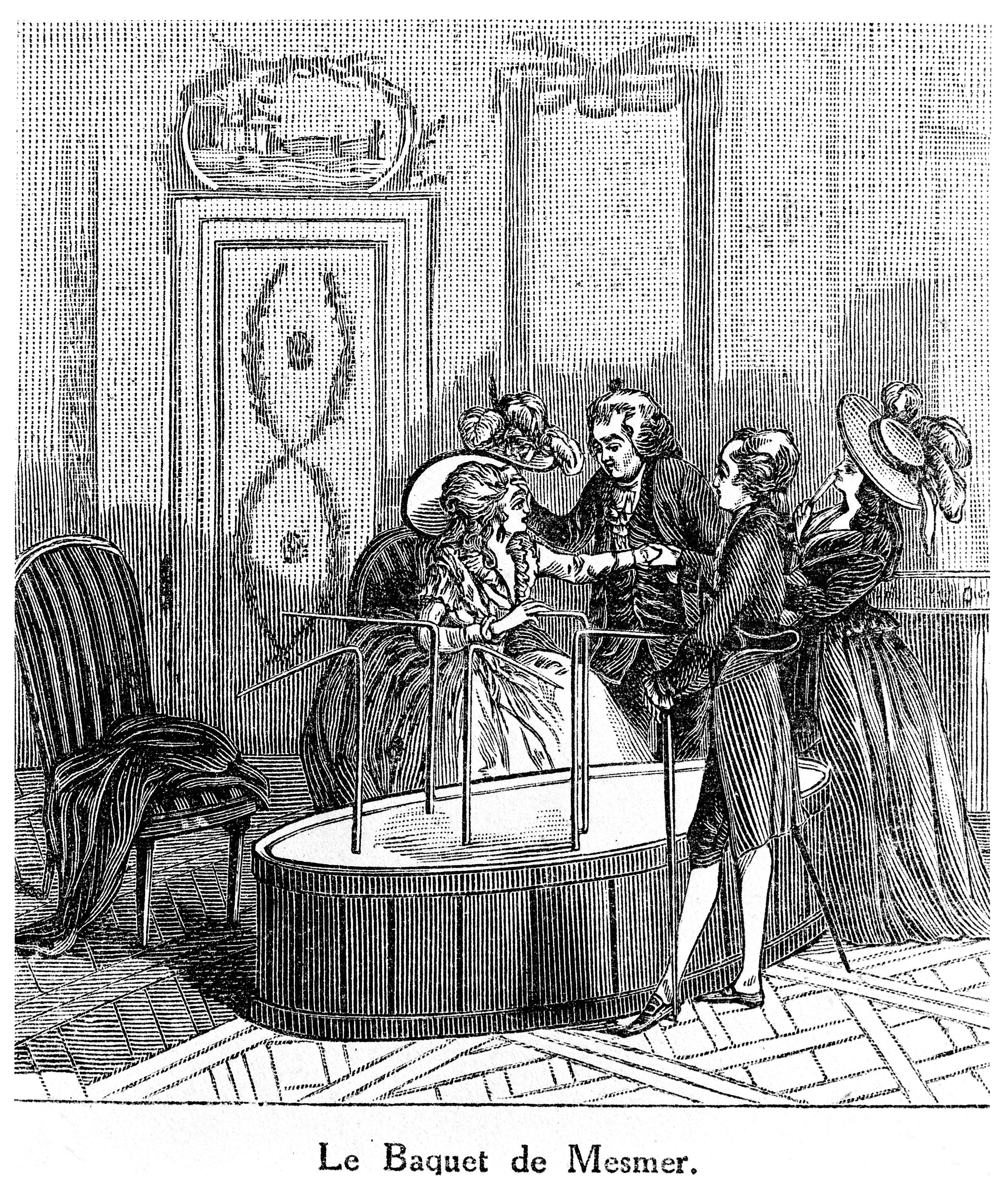
The commission of 1784 held Benjamin Franklin, then the American minister at Passy; Antoine Lavoisier; the astronomer Jean Sylvain Bailly; and Dr. Guillotin, whose name would shortly acquire other associations. What they built, much of it in Franklin’s garden, was a series of small, cheap, devastating arrangements. A woman who convulsed under magnetization was blindfolded and told she was being magnetized: she convulsed at nothing. A boy of known sensitivity was led among the trees of the garden, one of which had been magnetized; he fainted before he ever reached it. Lavoisier had written the logic out in advance: magnetize people without their knowledge, persuade others they are being magnetized when they are not, and one will obtain separately the effects of magnetism and the effects of the imagination. Bailly, carrying the findings to the Académie des Sciences that September, named what the commission had uncovered: facts, he wrote, for a science now new, the influence of the mental on the physical.1
What the commissioners were in fact inventing is the part of the story that has occupied me longest. They built, for the first documented time, an arrangement under which a claim’s failure would land on its owner: designed before the outcome, sealed against adjustment, with the verdict placed beyond the reach of everyone who wanted it to come out otherwise. The blindfold’s work was done to the claim, and only incidentally to the patient. It made the claim capable of costing Mesmer something. Mesmer, who had grasped all of this before the commissioners did, had designed his own proposed trial so that it could not.
A century and a half later the arrangement acquired its mathematics. Ronald Fisher’s The Design of Experiments opens with a woman who says she can taste whether the milk entered the cup before the tea. Fisher’s answer to her is the modern experiment: eight cups, four of each kind, the order settled not by human choice but, in his words, by the actual manipulation of the physical apparatus used in games of chance. The experimenter, the person with the most training and the most at stake, is precisely the one from whom control is removed, because the experimenter is the one with a rooting interest. Fisher was blunt about arrangements chosen rather than drawn: a layout the experimenter designs may share features with the very variation it is meant to rule out, and the test’s validity dies with the distinction. An arrangement the experimenter selects certifies nothing but the experimenter. And the whole apparatus exists, on Fisher’s account, only in order to give the facts a chance of disproving the null hypothesis.2 An experiment is a debt instrument. It is drawn up so that the world can collect.
The newest of these arrangements arrived in 2013. Under a registered report, a journal reviews a study’s question and design before any data exist, commits to publication on that basis, and binds the authors to the analysis they specified. The rate at which published studies confirm their own hypotheses tells you what the format does. In the standard psychology literature that figure sits near ninety-six percent: nearly everyone, it seems, guesses right. Under registered reports it falls to forty-four.3 Half a century of triumphant confirmation was the sound of a fee going uncollected.
I have been calling this property the practice’s liability, and the instruments in this history are one instrument. A practice is scientific to the degree that it maintains, in advance of any particular result and beyond its own power to revoke, arrangements under which its practitioners pay more when their claims are false than when they are true, and under which the collector is the world rather than any human authority. Five questions audit it: what is staked, what event calls the stake due, who collects, on what schedule, and whether the debtor can rewrite the terms. The third asks more than it seems to. A collector is the world to the degree that his own account moves with the truth of what he collects on and cannot be arranged by the debtor: the world is not a person, it is the name for the class of collectors whose payoffs the debtor cannot touch. A mathematics referee qualifies, because a proof is auditable by every reader who comes after him and a false pass is collected from his account by the next one. The Viennese faculty did not, and what happens then is the second half of this essay. The last question is the live one. Nearly every corruption the methodologists catalogue, the flexible analysis, the hypothesis composed after the results, the endpoint quietly switched, is a single act performed in different costumes: the debtor holding the pen that writes the terms of his own debt. And the reforms are a single act too. The blindfold, the lot, the shuffle, the registration: each takes the pen from the hand that owes.
Thomas Kuhn saw the shape of this in astrology, and I went looking for anyone who had read it as a claim about price and found no one. Against Popper he pointed out that astrologers made testable predictions constantly, that the predictions failed constantly, and that the failures changed nothing. His explanation ran through the puzzle: individual failures were uninformative, he wrote, and without puzzles, able first to challenge and then to attest the ingenuity of the individual practitioner, astrology could not have become a science even if the stars had, in fact, controlled human destiny.4 Read that passage with a ledger open and it says something Kuhn had no vocabulary to say. A puzzle is an invoice. A failed prediction inside a working science arrives addressed to someone: an anomaly some particular person must resolve at the price of their time, their standing, occasionally their theory. The astrologer’s failed prediction arrived addressed to no one. The heavens were subtle, the birth hour uncertain, the client forgetful. Astrology’s failures were free, and a practice whose failures are free can keep every belief it has forever.
Ptolemy is the objection that answers itself. Astronomy parked its anomalies in epicycles for a thousand years and stayed a science, so free failure at the level of doctrine cannot be the whole story, and it is not: an epicycle was a published computation, and its misfit with the next generation of tables landed on a named desk, priced in recomputation. Mercury’s misbehaving perihelion never knocked unanswered. Le Verrier staked a planet on it in print; the planet failed to exist; the debt sat addressed on astronomy’s ledger for fifty-six years until a new theory paid it. Failure was free for the paradigm and expensive at the desk, and the criterion asks only that some desk in the practice be charged. Kuhn found the mailbox. The ledger reads the mail.
Popper came within a sentence of all this. Rescuing a theory by evasive assumption is always possible, he conceded, but it rescues the theory only at the price of destroying, or at least lowering, its scientific status. There is the price, named. Now look at who pays it and who collects. The payment falls on the theory, an abstract object with no accounts. It is levied by the criterion itself, an instrument with no bailiff. And a community indifferent to the label pays nothing at all: no analyst felt poorer on the day psychoanalysis’s scientific status was lowered. Where he needed to charge, Popper legislated. His rules against evasion have exactly the force of a resolution: we decide, he wrote, that if our system is threatened we will never save it by any kind of conventionalist stratagem.5 A forbidden move and an expensive move are different devices. The first depends on everyone’s continued agreement. The second collects from defectors.
There is a second face to this, and I find it everywhere now. A method becomes an ornament at the moment its cost stops depending on whether you are wrong. The lab coat costs the same either way; it was born an ornament. The significance threshold began as a toll, and then the field learned flexible analysis, and passing it came to cost a true claim and a false claim the same afternoon’s work. Richard Feynman stood before Caltech’s graduating class in 1974 and described islanders rebuilding an airfield after the war: fires along the runway, a wooden hut, a man with two wooden pieces on his head like headphones. The form is perfect, Feynman said. It looks exactly the way it looked before. But it doesn’t work. No airplanes land. The speech is remembered as a charming scold about rigor. It is that. It is also an exact economic observation: every part of the airfield has been rebuilt except the part that was expensive.6

His own example was the charge of the electron. Millikan’s value was slightly wrong, a bad figure for the viscosity of air, and the measurements that followed crept toward the true number in polite increments, each experimenter trimming his result toward the last published one. Feynman asked why the record shows a creep rather than a correction. The ledger answers. For a young physicist, disagreeing with Millikan was expensive and agreeing with him was free: the creditor being paid was the faculty, in an arrangement whose entire purpose had been to leave the debt with the world. The same decay is now visible inside the reforms themselves: preregistrations written loosely enough to permit the very flexibility they exist to prevent, open-science badges collected the way medals are worn.7 Pseudoscience is the perfection of looking like science.
The criterion earns its keep on the cases that look like refutations of it. Ignaz Semmelweis stood in a Vienna hospital in 1847 with two maternity clinics and a mortality table showing one killing mothers at three times the rate of the other, traced the difference to the cadaveric matter on the examining doctors’ hands, cut the deaths to a fraction with a chlorine wash, and was driven from his post, from the city, and finally from his sanity. He died a fortnight after his committal, of sepsis: the disease he had spent his life naming. A cost arrangement operated in Viennese medicine, and it worked with terrible efficiency: it collected from Semmelweis. Read the parameters, though, and the case turns over. The party that collected was the faculty: the hierarchy of appointment, patronage, and doctrinal loyalty. The mortality tables were the world attempting to collect, and the practice kept no account the tables could reach. A discipline whose debts run to human authority will charge whatever that authority resents, and what it resents is frequently the truth. The punishment of the true claim is the predicted symptom of a practice owing the wrong creditor.8 The same reading covers the geologists who spent forty years pricing continental drift as an eccentricity charged against standing rather than employment: du Toit and Holmes kept their posts, and the coastlines lay in every schoolroom atlas all the while, fitting. The honest objection is that drift’s rejection was partly evidential: no mechanism had been offered, and the longitude numbers of the day ran against the rate the theory wanted. That objection is the criterion’s own point seen from below. The coastlines were never a test anyone’s account was bound to; no figure had been staked against the doctrine either way. A practice can hold every map in the world and owe nothing on any of them.
The harder case is the one with an honest instrument. Samuel Morton measured skulls with obsessive care; when anthropologists remeasured his collection in 2011, his numbers held, and the fudging he had long been accused of was found mostly in the accusation. The measurements were exposed to the world and stayed exposed for a hundred and seventy years. The doctrine they served, a ranking of races resting on polygenism, was positioned where no measurement could touch it: no cranial figure was ever specified, in advance or afterward, as the number that would unseat the ranking, and every connecting assumption, which populations count, what capacity means, which direction the inference runs, stayed in the doctrine’s hand. The liability ran from the calipers to the world and stopped before it reached the claim.9 That break in the chain is the signature, and it recurs wherever the statistics are impeccable and no conceivable finding could unseat the theory that commissioned them: an exposed instrument, an unreachable doctrine, the first paying the second’s debts in appearance only.
Then there is the gambler, who might seem to score perfectly, since no one’s errors are priced faster or by a colder collector. The criterion has a domain, and he was never inside it. Demarcation is a question about practices that issue claims for other people’s reliance. Astrology sells verdicts; psychoanalysis sells diagnoses; string theory asks a civilization for patience and for salaries. A betting syndicate asserts nothing to anyone: its exposure is private and self-liquidating, settled at the window. The question was never asked of private bets: from the courtroom to the classroom, demarcation has always been about which claims may be taught, funded, and relied on. And the window is where one science was born. Probability theory began as a gambler’s dispute made public, carried to Pascal and Fermat in 1654 and answered as a staked general claim. The criterion does not exclude the gambler; it names the transaction by which he becomes Cardano: publish the model, seal the terms, and stand where the record can collect. A fund that markets a sealed model to investors has made the same crossing, and the criterion says so without embarrassment: quantitative finance behaves science-like exactly where its claims are staked and audited, and stops behaving so exactly where they are not. The criterion sorts testimony. Of every practice that asks to be believed, it asks one thing: what would your assertions cost you if they were false.
A criterion of this kind punishes no one, and is not meant to: it is an audit, not a sentence. Its consumers are the third parties who must price a practice’s claims without being licensed to judge their content: the court, the funder, the editor, the reader deciding what to believe. Popper’s line could be drawn only by philosophers, and drawing it kept them occupied for fifty years. This one can be drawn by a clerk from documents the practice itself publishes. It convicts in a single pass the forensic disciplines a national academy needed a full report to convict, and for the stated reason: testimony under oath, immunity in practice, the debt due to no one. Laudan pronounced the demise of the demarcation problem, and he was right about the problem as posed: the deliverable was assumed to be a definition, conditions necessary and sufficient, and every candidate either exiled good science or naturalized bad. The audit changes the deliverable. Demarcation’s consumers never wanted a definition; they wanted a way to price reliance. And a boundary that sorts by degree is not a failed line. It is the first one shaped like the people who have to use it.
Deborah Mayo’s severity, the criterion’s nearest technical rival, grades tests: a claim passes severely only when the probe would probably have caught it were it false. The ledger grades the standing arrangements that decide which tests get built and whether their verdicts get honored. Severity without liability meets the last decade’s central mystery, a field manufacturing severe-looking tests whose costs no longer depended on being wrong, and can call it only coincidence; the ornament theorem calls it the predictable decay of any toll whose collector can be paid in costume. She assays the metal. The question here is who owns the mint. Michael Strevens prices the toil of empirical argument, and the toil is real, but toil that costs the same whether one is wrong or right is the lab coat again: only the differential disciplines.
A last obligation, which the history of this problem makes unavoidable. The verificationists drew a line around meaning, were eventually asked what their line verified about itself, and died of the question in two stages, self-stultifying in its strong form, vacuous in its weak one. A proposed boundary between science and its imitations is itself a claim offered for reliance, and owes what it says everything else owes. So before the research began I wrote down the findings that would refute this essay, each marked as kill or amend, and set out to produce them. The conditions now sit with a public registry under a timestamp: filed just before publication, which is what the timestamp proves and all it proves.10 Two partly arrived. Trial by ordeal, it turns out, ran for four centuries on real penalties for error, with the priest’s hand on the terms; the case forced the clause naming the world as collector, and that narrowing is a genuine retreat, reported here as one. And the scoring sorted the consensus cases only with that clause in the ledger; the gambler it could not sort at all, and he had to be met at the door.11 An amendment can be a rescue or a rearmament, and the difference is auditable: a rescue shrinks a claim’s exposure, and the clause grew it. The criterion now convicts the ordeal and the theologian alongside the astrologer, and stands exposed to any practice, this one included, whose collector’s account the debtor can reach. Two debts stay open on the ledger, named here so that no reviewer has to find them: nothing in these pages prices one currency of stake against another, and a debt due after every practitioner is dead has never constrained a living one. What you have been reading is the amended claim. The amendments are the receipt.
Mesmer asked for the lot in 1780 and kept the pen, and the history since is the long fight over that pen: the blindfolds at Passy, Fisher’s shuffled cups, the registration that outruns the data. The tub was theater, and everyone came to know it. The blindfold was an invoice. What the commissioners invented in Franklin’s garden was a way for a claim to owe something, and the art of telling science from everything dressed as science has been, ever since, the art of reading a practice for its creditor: who collects, when it comes due, and whose hand is on the terms.
Rapport des commissaires chargés par le Roi de l’examen du magnétisme animal (Paris: Imprimerie Royale, 1784), drafted by Bailly; Lavoisier’s design logic survives in his preparatory notes on the examination, Oeuvres de Lavoisier, vol. 3. The commission examined the practice of Charles Deslon, Mesmer’s most prominent disciple, which allowed Mesmer to disown the result. Mesmer’s own 1780 proposal, presented to the Faculté de Médecine on his behalf by Deslon, offered a comparative trial of twenty-four patients, twelve to each arm, allocation by the method of lots, with the details of treatment and examination fixed in advance; the Faculté rejected it out of hand and censured Deslon for presenting it. The proposal is preserved in Mesmer’s Précis historique des faits relatifs au magnétisme-animal (1781); I. M. L. Donaldson’s commentary for the James Lind Library treats it as among the earliest proposals of allocation by lot in a clinical trial; the commission’s report is available in Donaldson’s English translation, prepared for the Royal College of Physicians of Edinburgh. On the commission as the origin of blind assessment: Ted J. Kaptchuk, “Intentional Ignorance: A History of Blind Assessment and Placebo Controls in Medicine,” Bulletin of the History of Medicine 72, no. 3 (1998): 389–433. Bailly’s “science now new” line belongs to his Exposé to the Académie des Sciences of 4 September 1784, a companion document to the Rapport, and is cited to it here. Van Helmont had proposed a trial by lot for his own claims as early as 1648, a precedent Donaldson himself records, so the lot was not new with Mesmer. What the 1780 proposal is, is the first fully documented instance of a claimant demanding the ceremony of a test while retaining control of its terms: the rigged trial, four years before the commissioners built the honest one.
R. A. Fisher, The Design of Experiments (Edinburgh: Oliver and Boyd, 1935), ch. II, for the lady tasting tea, the games-of-chance formulation, and the null-hypothesis sentence. The case against self-designed layouts is Fisher’s campaign for randomization, conducted from “The Arrangement of Field Experiments,” Journal of the Ministry of Agriculture of Great Britain 33 (1926): 503–513, through the 1935 book; the body text states its substance without quotation.
Chris Chambers, “Registered Reports: A New Publishing Initiative at Cortex,” Cortex 49, no. 3 (2013): 609–610; Christopher Allen and David M. A. Mehler, “Open Science Challenges, Benefits and Tips in Early Career and Beyond,” PLOS Biology 17, no. 5 (2019): sixty-one percent of hypotheses in a sample of 113 registered reports went unsupported, against an estimated five to twenty percent null rate in the traditional literature; Anne M. Scheel, Mitchell R. M. J. Schijen, and Daniël Lakens, “An Excess of Positive Results: Comparing the Standard Psychology Literature with Registered Reports,” Advances in Methods and Practices in Psychological Science 4, no. 2 (2021): ninety-six percent support in standard articles, forty-four under registered reports. Theodore D. Sterling had already measured the standard literature’s positive rate at ninety-seven percent in 1959 (“Publication Decisions and Their Possible Effects on Inferences Drawn from Tests of Significance—or Vice Versa,” Journal of the American Statistical Association 54: 30–34), which dates the fee’s earliest audit. The forty-four is the interesting number: it is what a field’s success rate looks like when success can no longer be written after the fact, and its distance from ninety-six measures how much of the literature’s confirmation was purchased with the pen rather than the world. The comparison is observational rather than randomized, and with replication studies excluded the registered-report figure sits near fifty percent: the gap survives every cut of the data.
Thomas S. Kuhn, “Logic of Discovery or Psychology of Research?,” in Criticism and the Growth of Knowledge, ed. Imre Lakatos and Alan Musgrave (Cambridge: Cambridge University Press, 1970), 1–23, at 7–10; Popper’s reply, “Normal Science and Its Dangers,” follows at 51–58. The economic reading of the passage is mine: the literature on the Kuhn–Popper exchange treats the astrology argument as a point about puzzle-solving traditions, and nowhere, so far as I can find, as a point about the price of failure. Kuhn’s own gloss runs the other way from mine, toward sociology; but his sentence about failures that were “uninformative” concedes the ledger’s premise, since a failure that informs is a failure someone has been made to receive. Paul Thagard’s “Why Astrology Is a Pseudoscience” (1978) is the canonical development of Kuhn’s case and reads it through progress and community; the ledger is not his reading either.
Karl Popper, Conjectures and Refutations (London: Routledge and Kegan Paul, 1963), ch. 1, the price sentence at 36–37; The Logic of Scientific Discovery (London: Hutchinson, 1959), §20, for the resolution against conventionalist stratagems, with the surrounding discussion at §§19–20. The criticism that a forbidden move is a move priced at zero is, so far as I can establish, not in the literature in these terms. It should be pressed further than the body text presses it: a methodological rule binds only while the community keeps agreeing to it, which is why Popper’s system needs constant re-ratification, while a liability binds precisely the person who has stopped agreeing, which is why practices with real creditors survive their own heretics.
Richard P. Feynman, “Cargo Cult Science,” commencement address, California Institute of Technology, 1974; published in Engineering and Science 37, no. 7 (June 1974): 10–13. The Millikan discussion is in the same address. No one, so far as I can establish, has developed the address into a philosophical account rather than quoting it as decoration, which is its own small instance of the phenomenon: the most famous description of ornamental method circulates as an ornament.
On preregistrations loose enough to preserve the flexibility they exist to prevent: Marjan Bakker et al., “Ensuring the Quality and Specificity of Preregistrations,” PLOS Biology 18, no. 12 (2020), which scored preregistration strictness and found much of the flexibility intact; Olmo R. van den Akker et al., “Preregistration in Practice: A Comparison of Preregistered and Non-Preregistered Studies in Psychology” (2023), which found no robust evidence that preregistration as practiced prevents the p-hacking and selective reporting it was built against. The finding is the ornament theorem observed in real time, inside the instrument that was built against it, within a single decade of that instrument’s adoption: the decay of a cost device into a costume no longer takes a generation.
On Semmelweis: K. Codell Carter’s translation of Semmelweis, The Etiology, Concept, and Prophylaxis of Childbed Fever (Madison: University of Wisconsin Press, 1983), with Carter’s introduction on the reception. On drift: Naomi Oreskes, The Rejection of Continental Drift (New York: Oxford University Press, 1999); the evidential complication conceded in the body text, the missing mechanism and the geodetic numbers, is documented in her account, and the criterion’s reply is that an unstaked coastline is evidence to no one. The two cases are usually filed as indictments of scientific closed-mindedness, which mistakes the diagnosis for the disease: in each, the machinery of cost was operating at full force and was pointed at the faculty’s account rather than the world’s, so the machinery punished exactly what the faculty resented. The cases indict a creditor, and in doing so they concede that the creditor’s identity is where the whole question lives.
Jason E. Lewis et al., “The Mismeasure of Science: Stephen Jay Gould versus Samuel George Morton on Skulls and Bias,” PLoS Biology 9, no. 6 (2011); Jonathan Kaplan, Massimo Pigliucci, and Joshua Banta, “Gould on Morton, Redux,” Studies in History and Philosophy of Biological and Biomedical Sciences 52 (2015): 22–31, which finds fault on both sides of the remeasurement dispute. Morton’s case shows why the unit of assessment can be neither the instrument nor the man: the calipers were owed to the world and paid on schedule for seventeen decades, and the doctrine above them was never structured to owe anything at all. A practice is scientific to the degree its doctrines are reachable by its instruments’ creditors, and the reachability, since it was fixed by arrangements made in advance, can be audited without waiting to learn who was right.
The deposit: OSF Registries, DOI 10.17605/OSF.IO/2C7QY (osf.io/2c7qy), filed 20 July 2026, immediately before publication. The registry locks the text at submission and stamps it, so the date proves priority to publication and to nothing earlier: a distinction this essay is not entitled to blur. Part A of the deposit is the falsification conditions as written before the research was completed: prior ownership of the criterion in the literature; a practice with genuine error-contingent arrangements that is plainly not science; a reliably knowledge-producing practice with none; a field improved by lowering its error costs; failure of the criterion’s scoring to sort the consensus cases. Part B is the amended criterion’s standing exposure from publication forward: a world-collected, general-claiming practice that is plainly not science kills it; a plainly scientific practice issuing general claims with no such arrangements kills it; and amendment is permitted only where it grows the criterion’s exposure, reported as this essay reports its two. So far as I can find, no criterion in the problem’s history has filed its own falsification conditions with an independent custodian at all. The practice this essay describes is the practice it performs.
Larry Laudan, “The Demise of the Demarcation Problem,” in Physics, Philosophy and Psychoanalysis, ed. R. S. Cohen and L. Laudan (Dordrecht: Reidel, 1983), 111–127. The nearest existing relative of the present proposal is Robin Hanson, “Could Gambling Save Science? Encouraging an Honest Consensus,” Social Epistemology 9, no. 1 (1995): 3–33, which builds the full machinery of staked claims and ex ante wording as an institutional reform while leaving the definition of science to Popper: the machinery aimed at the other question. Peter T. Leeson, “Ordeals,” Journal of Law and Economics 55, no. 3 (2012): 691–714, supplies the case that forced the world-creditor clause: four centuries of real penalties, administered under a trigger the priest controlled. On the self-application that killed verificationism: A. J. Ayer, Language, Truth and Logic, 2nd ed. (London: Victor Gollancz, 1946), introduction; Carl G. Hempel, “Problems and Changes in the Empiricist Criterion of Meaning,” Revue Internationale de Philosophie 4, no. 11 (1950): 41–63. The adjacent contemporary accounts, met in the body text above, are Deborah Mayo’s severity (Statistical Inference as Severe Testing, Cambridge: Cambridge University Press, 2018), a property of tests where the present proposal concerns the standing arrangements that produce severe tests, and Michael Strevens’s iron rule (The Knowledge Machine, New York: Liveright, 2020), whose cost is the error-independent toil of empirical argument where everything here turns on the differential. Massimo Pigliucci’s cluster account, in Pigliucci and Boudry, eds., Philosophy of Pseudoscience (Chicago: University of Chicago Press, 2013), is the criterion’s nearest going rival: a family of traits, where the ledger claims to explain why the traits cluster. Nassim Taleb’s Skin in the Game (New York: Random House, 2018) holds the popular register of liability without offering a criterion. Ian Hacking’s The Emergence of Probability (Cambridge: Cambridge University Press, 1975) carries the 1654 genealogy. And the Daubert factors, testing, known error rate, peer review, are liability proxies already in judicial use, which makes the clerk of the closing movement less hypothetical than he sounds. The forensic conviction in the body refers to National Research Council, Strengthening Forensic Science in the United States: A Path Forward (Washington, DC: National Academies Press, 2009), a full report whose verdict the five questions duplicate in an afternoon. Every earlier criterion was offered as a verdict on other practices; this one is offered with its falsification conditions stated in advance, which is another way of saying it is offered for collection.
This is genuinely striking. Tracing demarcation back to Mesmer's rigged trial and Fisher's shuffled cups, then landing on "what would your assertions cost you if they were false" as the actual test, gives the problem a mechanism instead of just a definition. The Semmelweis and Morton cases are where it really earns its keep, since they show the difference between a claim's instrument being liable and the doctrine behind it being liable. And filing the falsification conditions in a public registry before publishing is a stellar bit of the essay practicing what it preaches. Masterful work, Barnes, as always.